Friday, September 26, 2014

The Return

 
by Ezra Pound
 
THE RETURN
 
See, they return; ah, see the tentative
Movements, and the slow feet,
The trouble in the pace and the uncertain
Wavering!
 
See, they return, one, and by one,
With fear, as half-awakened;
As if the snow should hesitate
And murmur in the wind,
and half turn back;
These were the "Wing'd-with-Awe,"
inviolable.
 
Gods of the winged shoe!
With them the silver hounds,
sniffing the trace of air!
 
Haie! Haie!
These were the swift to harry;
These the keen-scented;
These were the souls of blood.
 
Slow on the leash,
pallid the leash-men!
 
(1913)
 
THE COMING OF WAR: ACTAEON
 
An image of Lethe,
and the fields
Full of faint light
but golden,
Gray cliffs,
and beneath them
A sea
Harsher than granite,
unstill, never ceasing;
High forms
with the movement of gods,
Perilous aspect;
And one said:
"This is Actaeon."
Actaeon of golden greaves!
Over fair meadows,
Over the cool face of that field,
Unstill, ever moving,
Host of an ancient people,
The silent cortege.
 
(1915)
 
BIO:  Born in Hailey, Idaho on 30 October 1885, Ezra Pound taught at Wabash College for two years, until he became the London editor of "The Little Review." He was immensely interested in travel and poetry, especially Chinese and Japanese poetry. These Eastern influences are clearly discernible in his own poetry, which is known for its clarity, precision, and economy of language. In 1924 he moved to Italy, where he became involved in Mussolini's fascist movement. When he returned to the U.S. in 1945, he was arrested for treason.  Acquitted in 1946, he was declared mentally ill and committed to St. Elizabeth Hospital in Washington, D.C., where he remained until 1958.  Ho profoundly influenced the writing and careers of such noted poets as W.B. Yeats, Robert Frost, William Carlos William, and T.S. Eliot.


Wednesday, August 13, 2014

Sing Me a Lullaby


Sweet and Low
 
by Alfred, Lord Tennyson
 
Sweet and low, sweet and low,
Wind of the Western sea;
Low, low, breathe and blow,
Wind of the Western sea;
Over the rolling waters go,
Come from the dying moon and blow,
Blow him again to me,
While my little one,
While my pretty one sleeps . . .
 
To the Evening Star
 
from Wagner's "Tannhauser"
 
O thou sublime sweet evening star!
Joyful I greet thee from afar.
With glowing heart that ne'er disclos'd,
Greet her when she in thy light reposed.
When parting from this vale, a vision,
She rises to an angel's mission,
When parted from this vale, a vision,
She rises to an angel's mission.

When at Night I Go to Sleep

from Humperdinck's "Hansel and Gretel"

When at night I go to sleep,
Fourteen angels watch do keep:
Two my head are guarding,
Two my feet are guiding.
Two are on my right hand,
Two are on my left hand.
Two my asleep attending,
Two awake me bending.
Two point out when I arise
The way to heavenly paradise.

All Through the Night

A Welsh Lullaby

Sleep, my child, and peace attend thee,
All through the night.
Guardian angels God will send thee,
All through the night.
Soft, the drowsy hours are creeping,
Hill and dale in slumber sleeping.
I, my loved ones' watch am keeping,
All through the night.

Angels watching, e'er around thee,
All through the night.
Midnight slumber close surround thee,
All through the night.
Soft, the drowsy hours are creeping,
Hill and dale in slumber sleeping,
I, my loved ones' watch am keeping,
All through the night.

Brahms' Lullaby

by Johannes Brahms

Lullaby and good-night, with roses bedight,
With lilies o'er spread is baby's wee bed.
Lay thee down now and rest, may thy slumber be blessed.
 
Dutch Lullaby
 
by Eugene Field
 
Wynken, Blynken, and Nod one night
Sailed off in a wooden shoe,--
Sailed on a river of misty light
Into a sea of dew.
"Where are you going, and what do you wish?"
The old moon asked the three.
"We have come to fish for the herring-fish
That live in this beautiful sea;
Nets of silver and gold have we,"
Said Wynken,
Blynken,
And Nod.
 
The old moon laughed and sung a song,
As they rocked in the wooden shoe;
And the wind that sped them all night long
Ruffled the waves of dew;
The little stars were the herring-fish
That lived in the beautiful sea.
"Now cast your nets wherever you wish,
But never afeard are we!"
So cried the stars to the fishermen three,
Wynken,
Blynken,
And Nod.
 
All night long their nets they threw
For the fish in the twinkling foam,
Then down from the sky came the wooden shoe,
Bringing the fishermen home;
'T was all so pretty a sail, it seemed
As if it could not be;
And some folk thought 't was a dream they'd
dreamed
Of sailing that beautiful sea;
But I shall name you the fishermen three:
Wynken,
Blynken,
And Nod.
 
Wynken and Blynken are two little eyes,
And Nod is a little head,
And the wooden shoe that sailed the skies
Is a wee one's trundle-bed;
So shut your eyes while Mother sings
Of wonderful sights that be,
And you shall see the beautiful things
As you rock on the misty sea
Where the old shoe rocked the fishermen three,--
Wynken,
Blynken,
And Nod.


GOOD-NIGHT AND SWEET DREAMS!

Rest in Peace, Robin Williams and Lauren Bacall (2014)


Thursday, July 31, 2014

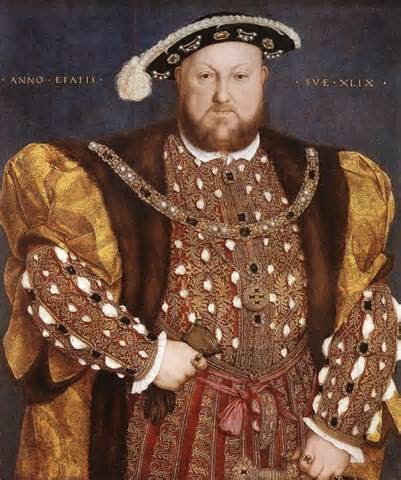
Poems by King Henry VIII

 
King Henry VIII
 
 
The Time of Youth is to be Spent

The time of youth is to be spent,
But vice in it should be forfent.
Pastimes there be, I note truly
Which one may use and vice deny.
And they be pleasant to God and man:
Those should we covet when we can,
As feats of arms, and such other
Whereby activeness one may utter.
Comparisons in them may lawfully be set,
For, thereby, courage is surely out fet.
Virtue it is, then, youth for to spend
In good disports which it does fend.

 
Green Groweth the Holly  


Green groweth the holly, so doth the ivy.
Though winter blasts blow never so high,
Green groweth the holly.

As the holly groweth green
    And never changeth hue,
So I am, and ever hath been,
    Unto my lady true.
            Green groweth the holly, so doth the ivy.
            Though winter blasts blow never so high,
            Green groweth the holly.

As the holly groweth green,
    With ivy all alone,
When flowerys cannot be seen
    And green-wood leaves be gone,

              Green groweth the holly, so doth the ivy.
              Though winter blasts blow never so high,
                Green groweth the holly. 
                

Now unto my lady
    Promise to her I make:
From all other only

    To her I me betake.
                Green groweth the holly, so doth the ivy.
                Though winter blasts blow never so high,
                   Green groweth the holly. 

Adieu, mine own lady,
    Adieu, my specïal,
Who hath my heart truly,
    Be sure, and ever shall.

Green groweth the holly, so doth the ivy.
Though winter blasts blow never so high,
Green groweth the holly. 


Though that Men do Call it Dotage


Though that men do call it dotage,
Who loveth not wanteth courage;

And whosoever may love get,
From Venus sure he must it fet,

Or else from her which is her heir,
And she to him must seem most fair.

With eye and mind doth both agree.
There is no boot: there must it be.

The eye doth look and represent,
But mind afformeth with full consent.

Thus am I fixed without grudge:
Mine eye with heart doth me so judge.

Love maintaineth all noble courage.
Who love disdaineth is all of the village:

Such lovers—though they take pain—
It were pity they should obtain,

For often times where they do sue
They hinder lovers that would be true.

For whoso loveth should love but once.
Change whoso will, I will be none.
 
Definitions: forfent=forbidden, fet=gained, fend=protect
BIO:  King Henry VIII of England and Ireland (1491-1547)--bold, brash, and demanding-- was forced to marry his brother's widow, Catherine of Aragon. The marriage was not a happy one and produced only one child, Mary Tudor. Henry wanted a son who would succeed to the throne. After much violent debate, Henry broke away from the Holy Roman Catholic Church and divorced Catherine. His second wife, Anne Boleyn, gave birth to the future queen, Elizabeth, but was thereafter accused of adultery and beheaded. Henry's third wife, Jane Seymour, produced Edward VI, to Henry's great delight, and then died in 1551. Fourth wife, Anne of Cleves, was divorced. Fifth wife, Catherine Howard, was beheaded. Henry's sixth wife, Katherine Parr, survived Henry's death in 1547. One of Henry's hymns, O Lord, the Maker of all Things, can still be occasionally heard in English cathedrals.


Tuesday, June 10, 2014

I Remember You


by Dawn Pisturino
 
I remember you:
Those violet eyes that any girl would envy;
The full lips curled into a boyish smile;
The long, tapered fingers and moist, warm hands.
Yes, I remember you,
For I loved you with all the romance
Of girlish dreams,
And whiled away the hours thinking only of you.
I lived for the simple touch of your hand
And sighed for a single kiss from your lips
And died for a kindly smile in those eyes,
O foolish dreamer that I was!
But my dream was more real to me than life itself,
And I hungered to wed dream to reality.
If you ever knew - or dared to know - my love for you,
It was not apparent in the course of time,
And O! how I wept the bitter tears of unrequited love --
That Great Enemy of adolescence which betrays the heart so well!
Yes, I remember you;
If you would but remember me as a simple child,
I would be happy.
 
July 29, 1986
"Rosemary for Remembrance"
 
BIO:  Dawn Pisturino's poems, limericks, short stories, and articles have appeared in/on Danse Macabre du Jour, Brooklyn Voice, Underneath the Juniper Tree, Working Writer, and several newspapers and anthologies. She currently resides in Arizona.


Thursday, February 6, 2014

Holly's Blues


by Margaret Flint Suter
 
Better to go lightly on that page
It has shattered glass
Among the ruined grass.
 
Move along in quick time
Past the pain markers --
Crimson dripped on navy.
 
Go lightly past the sparkling gems
That mirror failure
In multi-faceted mockery.
 
Toast to trials, hold your glass high
Beneath the fire escape, a mask worn on each landing
A life re-made at every turn.
 
Go lightly down that avenue
Where Holly's hurt spread thick fingers
Into heartache and split the muscle open.
 
Wait in the rain
For a cat that must return
Call into the alleys along the dream street.
 
Lift the lids on all the dumpsters stinking of despair
All the while sniffing hope
Under the coffee grounds.
 
Listen for the voice
Of cat calling
In return to Holly's blues.
 
Listen as his voice fades
Beneath the storm
While Holly weeps.
 
Weeps among the alley ends
Until she crumples
Mean reds flaring around her basic black life.
 
Touch the color of Holly's blues
Feel her sorrow
In pulse of neon.
 
Rain sibilant
Against your ear
Hold Holly while she weeps.
 

©Copyright 2007-2014 Margaret Flint Suter. All Rights Reserved.
Based on the book Breakfast at Tiffany's by Truman Capote and the Hollywood film starring Audrey Hepburn and George Peppard.

Read more works by Margaret Flint Suter

"Bone Music"
Published in the November 2011 issue of Underneath the Juniper Tree.

"Sweetest Halloween"
Published in the October 2013 issue of Underneath the Juniper Tree

"Lavender and Lilac: 'Til Death Do Us Part"
Published in the December 2013 issue of Underneath the Juniper Tree

"Balthasar's Box"
Second Place winner, Poemeleon Poetry Journal

"Redemption Box"
Runner Up, Poemeleon Poetry Journal
 
Bio: Margaret Flint Suter served her country in the U.S. Navy as a cryptologic technician. She now serves up tantalizing stories and poems to her many readers -- both children and adults. A doting mother and grandmother, Suter embraces many worthy causes that contribute to the betterment of humanity.


Monday, February 3, 2014

THE TRAIL'S END - The Story of Bonnie and Clyde

 
written by gangster Bonnie Parker
 
THE TRAIL'S END
 
You've read the story of Jesse James
of how he lived and died.
If you're still in need
of something to read,
here's the story of Bonnie and Clyde.
 
Now Bonnie and Clyde are the Barrow gang.
I'm sure you all have read
how they rob and steal;
and those who squeal,
are usually found dying and dead.
 
There's lots of untruths to these write-ups.
They're not as ruthless as that.
Their nature is raw;
they hate all the law,
the stool pigeons, spotters, and rats.
 
They call them cold-blooded killers.
They say they are heartless and mean.
But I say this with pride
that I once knew Clyde,
when he was honest and upright and clean.
 
But the law fooled around;
kept taking him down,
and locking him up in a cell.
'Til he said to me:
'I'll never be free,
so I'll meet a few of them in hell."
 
The road was so dimly lighted
there were no highway signs to guide.
But they made up their minds;
if all roads were blind,
they wouldn't give up 'til they died.
 
The road gets dimmer and dimmer.
Sometimes you can hardly see.
But it's fight man to man
and do all you can,
for they know they can never be free.
 
From heartbreak some people have suffered.
From weariness some people have died.
But take it all in all;
Our troubles are small,
'til we get like Bonnie and Clyde.
 
If a policeman is killed in Dallas
and they have no clue or guide,
if they can't find a fiend,
they just wipe their slate clean
and hang it on Bonnie and Clyde.
 
There's two crimes committed in America
not accredited to the Barrow mob.
They had no hand;
in the kidnap demand,
nor the Kansas City Depot job.
 
A newsboy once said to his buddy:
'I wish old Clyde would get jumped.
In these awful hard times,
we'd make a few dimes,
if five or six cops would get bumped.'
 
The police haven't got the report yet
but Clyde called me up today.
He said, 'Don't start any fights;
we aren't working nights,
we're joining the NRA.'
 
From Irving to West Dallas viaduct
is known as the Great Divide,
where the women are kin,
and the men are men,
and they won't 'stool' on Bonnie and Clyde.
 
If they try to act like citizens
and rent them a nice little flat,
about the third night,
they're invited to fight,
by a sub-gun's rat-tat-tat.
 
They don't think they're too smart or desperate,
they know that the law always wins.
They've been shot at before;
but they do not ignore
that death is the wages of sin.
 
Some day they'll go down together.
They'll bury them side by side.
To few it'll be grief,
to the law a relief,
but it's death for Bonnie and Clyde.
 
Bio:  Bonnie Parker was born on October 1, 1910 in Rowena, Texas. She met ex-con Clyde Barrow in January 1930 while working as a waitress. The pair instantly fell in love. Bonnie followed Clyde on a 21-month crime spree across Texas, Oklahoma, New Mexico, and Missouri, which ended in a deadly massacre at Gibsland, Louisiana on May 23, 1934. 
 

Monday, December 23, 2013

A Victorian Christmas

 
MY GIFT
 
What can I give Him
Poor as I am?
If I were a shepherd,
I would give Him a lamb,
If I were a Wise Man,
I would do my part --
But what can I give Him,
Give my heart.
 
Christina Rossetti
 
CHRISTMAS BELLS
 
The time draws near the birth of Christ:
The moon is hid, the night is still;
The Christmas bells from hill to hill
Answer each other in the mist.
 
Four voices of four hamlets round,
From far and near, on mead and moor,
Swell out and fail, as if a door
Were shut between me and the sound;
 
Each voice four changes on the wind,
That now dilate, and now decrease;
Peace and good will, good will and peace;
Peace and good will to all mankind.
 
Alfred, Lord Tennyson
 
A SONG FOR A CHRISTMAS TREE
 
Cold and wintry is the sky,
Bitter winds go whistling by,
Orchard boughs are bare and dry,
Yet here stands a faithful tree.
Household fairies kind and dear,
With loving magic none need fear,
Bade it rise and blossom here,
Little friends, for you and me.
 
Come and gather as they fall,
Shining gifts for great and small;
Santa Claus remembers all
When he comes with goodies piled.
Corn and candy, apples red,
Sugar horses, gingerbread,
Babies who are never fed,
Are handing here for every child.
 
Shake the boughs and down they come,
Better fruit than peach or plum,
'T is our little harvest home;
For though frosts the flowers kill,
Though birds depart and squirrels sleep,
Though snows may gather cold and deep,
Little folks their sunshine keep,
And mother-love makes summer still.
 
Gathered in a smiling ring,
Lightly dance and gaily sing,
Still at heart remembering
The sweet story all should know,
Of the little child whose birth
Has made this day throughout the earth
A festival for childish mirth,
Since the first Christmas long ago.
 
Louisa May Alcott
 
MERRY CHRISTMAS, EVERYONE!